A Claude Motion alternative with real 3D, no Team plan needed.

Claude Motion turns your reports, charts and images into short animated explainers inside Claude, on Team and Enterprise plans. Paraplex's assistant runs on the same Claude models inside a full 3D motion editor: real glass, chrome and light, a keyframe timeline you can finish by hand, voiceovers, and one scene exported for every screen, with a free plan anyone can start on.

Unlimited free 1080p exports.  No watermark.  Runs in your browser.

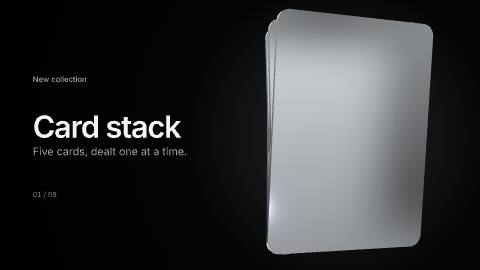
The Card stack, chrome template made in Paraplex: five thin cards of polished chrome fan up from below and are dealt off one at a time, reflections sliding over the metal as they turn

Paraplex vs Claude Motion, feature by feature

As of October 29, 2026
Paraplex and Claude Motion compared feature by feature, as of October 2026
ParaplexClaude Motion
Where it runsIn a browser tab, nothing to install; projects sync once you sign inInside Claude on the web and desktop, as an artifact made from the Motion template; start with /motion or Output › Motion in any chat
Status and priceFree plan with 1080p exports, no watermark and 100 AI credits a month; Pro $19/mo billed yearly or $24 month to monthBeta since October 8, 2026, on Claude Team and Enterprise only, not Free, Pro or Max; Team from $20 per seat a month billed yearly; counts toward plan usage
Built forFinished motion: launch and demo videos, social cuts, animated type and charts, website heroesShort explainers from your own content: an all-hands recap, an animated chart for a board deck, a product walkthrough
3DEvery scene is real 3D: physically based glass, chrome and metal, lights, HDRI and shadows; path-traced Studio render (Pro)No 3D materials, lights or camera in Anthropic's documentation; no realistic footage or people
AIAn assistant on Claude models you pick, with 140 tools for layers, keyframes, camera moves, materials and charts; every turn a preview you Apply or DiscardClaude writes the animation as code that animates your text, charts, shapes and images; no video generation model
EditingA keyframe on every setting, 23 easing presets and springs, 40+ text presets; or ask the assistantAsk Claude for changes in chat or adjust it in the editor; one word, number or timing changes and the rest stays
LengthA second up to an hour, at 10 to 120 fpsNo maximum published; Anthropic's examples run about 30 s, and a hands-on review reports requests of up to 5 minutes
Video exportMP4 and WebM, plus GIF, PNG and Lottie; Free 1080p at 30 fps, Pro up to 4K at 60 fps; transparent WebM and PNG sequences on bothMP4 download or a share link; resolution and frame rate not published
Audio and captionsElevenLabs voiceovers with word-by-word captions, AI sound effects and music, beat detection; SRT and WebVTT exportNo voiceover or captions documented; a hands-on review reports generated music
Every aspect ratioArtboards for 16:9, 9:16, 1:1, 4:5 and 4:3 with Responsive framing and social safe zones; export all enabled in one goAsk for a size such as 1080×1920 in the prompt; no per-format artboards documented
Handoff and webLive interactive embed (hover, click, drag, scroll); code layers run HTML, React and GSAP on the timeline, including Claude Motion codeOpen in Adobe, Descript, HeyGen, Higgsfield, invideo, Luma AI or Runway; Canva and Captions coming soon
DataCharts from a pasted CSV of up to 400 rows; one version per spreadsheet row, batch export on ProBuilt from the report, data or images you attach; sits beside Claude Dashboards for live data
CollaborationShareable links, an editable copy by link, notes on the canvas; no real-time co-editingShared as a Claude artifact; a hands-on review reports comments pinned to a moment on the timeline; owners control access

Claude Motion has been in beta since October 8, 2026, and Anthropic hasn't published its export resolution, frame rate, aspect ratios or a maximum length, so check Anthropic's help center for anything newer than October 29, 2026. Cells that say "a hands-on review" come from independent reviews, not from Anthropic. The gaps run both ways: Claude Motion wins on starting inside Claude, building from your own documents and longer pieces; Paraplex wins on 3D light, hand-finished keyframes, every-format export, voice and the web.

Sources: Get started with Claude Motion (Claude Help Center), Build live dashboards and animate explainers with Claude (Anthropic, October 8, 2026), Claude Motion review (eesel AI, October 2026, includes Claude plan prices), Claude Motion and Dashboards, hands-on (How to AI, October 2026), Paraplex pricing.

The short version.

Paraplex

Choose Paraplex if you need

Motion you can make without a Claude Team or Enterprise plan, starting free with 1080p exports and no watermark

Real 3D: glass, chrome and metal lit by studio lights and HDRI environments, with a path-traced Studio render on Pro

A keyframe timeline you finish by hand, with every AI change previewed before you keep it

One scene reframed for 16:9, 9:16, 1:1, 4:5 and 4:3, up to 4K at 60 fps on Pro

Voiceovers with word-by-word captions, transparent video and a live embed for your website

Claude Motion

Choose Claude Motion if you need

An explainer made in the same Claude chat where your report, deck or data already lives

An animation built straight from the documents you attach, with no new tool to learn

Explainers you revise by replying in the chat, with no editor to open

Live dashboards alongside it, with Claude Dashboards

Nothing new to buy, if your company already pays for Claude Team or Enterprise

Both

Both run on Anthropic's Claude models, build motion from editable parts rather than generated footage, change one word or number without rebuilding the rest, and export MP4. A Claude Motion animation can also come into Paraplex to be finished.

Three differences that change what you can make.

Claude Motion is the quickest way to animate a report your team already has in Claude. These are the places where a piece needs more than an explainer.

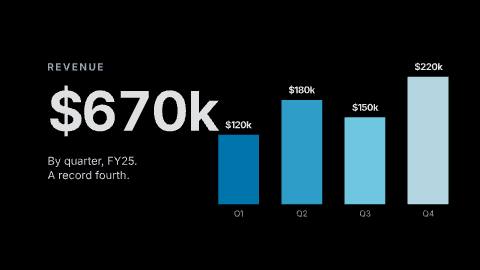
The Chart drop template made in Paraplex: a revenue total counts up beside a short headline while four bars grow one after another on a dark ground

01

Real light and materials, not flat explainers.

As of October 2026, Claude Motion writes code that animates the text, charts, shapes and images in your prompt and plays it like a short video. Anthropic says it doesn't use a video generation model, and its documentation describes no 3D materials, lights or camera.

Every Paraplex scene is real 3D: physically based glass, chrome and metal, lights you place and animate, 11 environments and 8 HDRI panoramas, cast shadows and a camera with depth of field. A chart can stand in that light too, with every bar, label and axis a layer, and a path-traced Studio render is on Pro.

More on 3D motion graphics and animated charts.

Paraplex

Physically based materials, lights, HDRI, shadows and a 3D camera

Claude Motion

Animated text, charts, shapes and images; no 3D in its documentation

02

A timeline you can finish by hand.

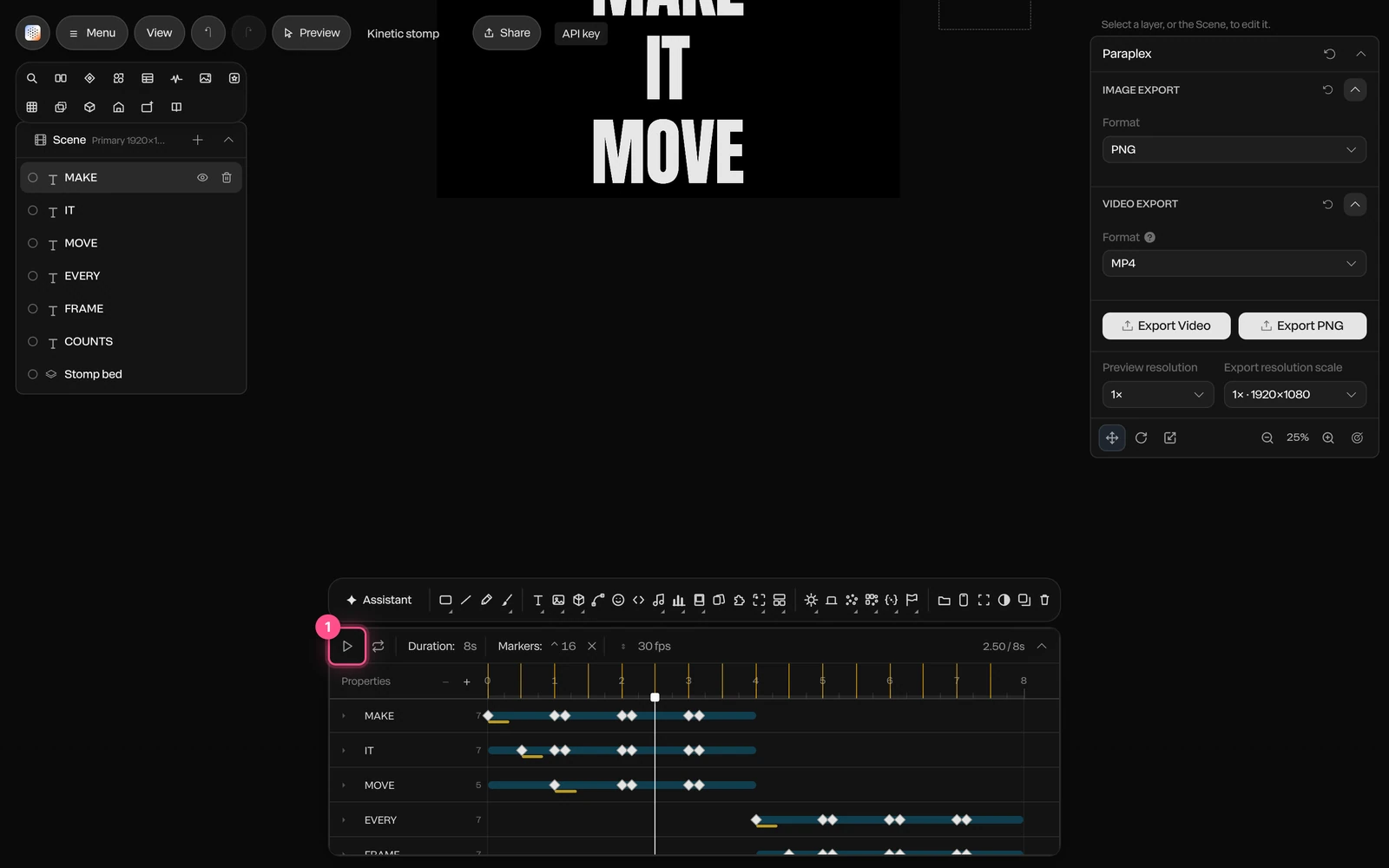
In Claude Motion you refine an animation by asking Claude, such as “slow down the second scene”, or by adjusting it in its editor. Because the animation is code, one word, number or timing changes and the rest stays as it was.

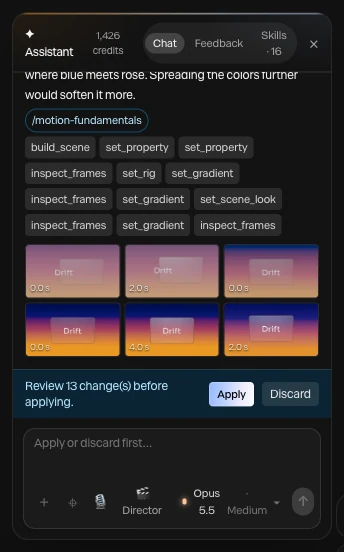
Paraplex's assistant works inside a full motion editor with 161 tools. Every turn is a preview you Apply or Discard, applied changes undo in one step, and what it makes is ordinary layers and keyframes, with 23 easing presets and springs, that you can drag, retime and restyle by hand.

More on the AI assistant and AI motion design.

Paraplex

Keyframes on every setting; AI turns you Apply or Discard

Claude Motion

Ask Claude or adjust it in the editor; edits stay code

03

Every format, a voice and the web.

Claude Motion exports an MP4 or a share link. Anthropic hasn't published its resolution or frame rate, and you ask for a size such as 1080×1920 in the prompt. A hands-on review reports generated music, but no voiceover.

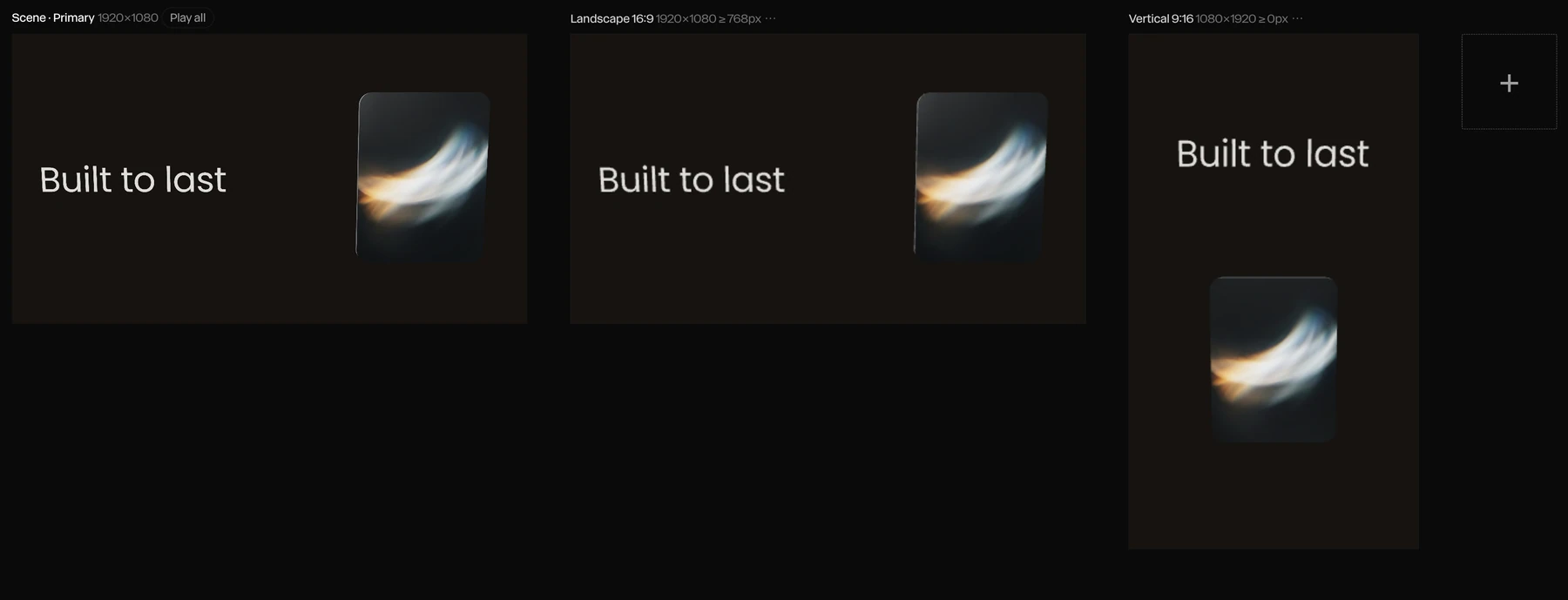
In Paraplex, add 9:16, 1:1, 4:5 or 4:3 artboards and the scene reframes for each, with social safe zones, then export every enabled format in one go, up to 4K at 60 fps on Pro. Type a script for an ElevenLabs voiceover with a caption on every word, export a transparent WebM, or publish the scene as a live embed that answers hover, click, drag and scroll.

More on every aspect ratio, social media videos and website hero animations.

Paraplex

Artboards per format, voiceover with captions, 4K (Pro), live embed

Claude Motion

MP4 or a share link; specs not published; no voiceover

When Claude Motion is the better choice.

Claude Motion is built for the explainers a company needs every week, and it lives where many teams already work. As of October 2026, pick it in these cases, or use both: draft the explainer in Claude Motion, then finish it in Paraplex.

It's already in your Claude chat.

Type /motion or pick Output › Motion in the chat you're already in, with your files and context. There's no new app, login or editor to learn.

Straight from the report.

Attach a quarterly report, a pricing table or a set of setup steps, and Claude builds the animation from your own content and numbers. Check every figure against the source before you share it.

Revise it by replying.

Ask for a slower reveal or a different chart in the same chat and Claude rewrites the animation for you. There's no timeline or keyframe to touch, which suits people who never want to open an editor.

Next to live data.

Claude Dashboards, launched the same day, builds live dashboards from sources such as BigQuery, Snowflake and Databricks, so the dashboard answers the question and the animation tells the story.

Hand it to your video tools.

Anthropic names Adobe, Descript, HeyGen, Higgsfield, invideo, Luma AI and Runway as places to open a Claude Motion animation and keep editing, with Canva and Captions coming soon.

Your company already pays for Claude.

Claude Motion comes with Team and Enterprise at no separate fee and counts toward each person's usage limits. On Enterprise, an owner turns it on in Organization settings.

Use both: start in Claude Motion, finish in Paraplex.

A Claude Motion animation is code, and Paraplex runs code as a layer, so a draft from Claude can keep going here: into real light, with a voice, in every format.

Bring the code across.

Paraplex runs HTML, CSS, JavaScript and GSAP as a code layer on its own timeline clock, so a Claude Motion animation plays and exports frame for frame. More on code layers.

Put it in real light.

Place the animation in front of the scene, behind it or on a card in 3D space, then surround it with glass, chrome, studio lights and an HDRI environment.

Give it a voice.

Type a script for an ElevenLabs voiceover with a caption on every word, add AI sound effects and music, and snap cuts to the beat.

Ship every cut.

Reframe it for 9:16, 1:1, 4:5 and 4:3, export up to 4K at 60 fps on Pro, or publish it as a live embed on your site.

Or have Claude build it in Paraplex.

If you work in Claude Code, the Paraplex MCP server lets Claude build in your open Paraplex tab with the same tools the assistant uses: it adds and changes layers, looks at frames and exports video. Every edit shows in the tab as one undo step, and the server runs only on your computer.

Set it up with the Claude Code guide, or see what AI agents can do in Paraplex.

Other Claude Motion alternatives.

Paraplex isn't the only option. If your work leans a different way, these are worth a look, as of October 2026.

Best for quick 2D motion with templates

Jitter

A browser-based 2D motion tool with a large template library, a Figma plugin, real-time team editing and a free plan.

Paraplex vs Jitter

Best for VFX and compositing footage

After Effects

Adobe's desktop standard for compositing, visual effects on footage and plugin-heavy workflows, sold by subscription.

Paraplex vs After Effects

Best for UI motion inside the design file

Figma Motion

Figma's timeline for interface motion, with code handoff in Dev Mode, real-time co-editing and Lottie export, in open beta for Full seats.

Paraplex vs Figma Motion

Best for one-prompt launch videos

Hera

A prompt-to-video agent that writes animation as code, with each element an editable object in a scene-by-scene editor, exporting MP4, MOV or GIF, with a free tier.

Best for developers who want the code

Claude Code with Remotion

Have Claude Code write a Remotion project in React and render the MP4 yourself, on any Claude plan that includes Claude Code. You keep the code and run the render.

Questions about Paraplex and Claude Motion

What is the best Claude Motion alternative?

It depends on what the animation is for. As of October 2026, Claude Motion is a strong fit for short explainers built from your own reports and data inside Claude, on Team and Enterprise plans. For finished motion with real 3D light and materials, a keyframe timeline, voiceovers and every aspect ratio, Paraplex is a browser-based alternative that runs on Anthropic's Claude models and has a free plan. Claude Code with Remotion suits developers who want to own the code, and After Effects suits visual effects and compositing on footage.

Can I use Claude Motion on Claude Pro or Max?

No. As of October 2026, Claude Motion is in beta on Claude Team and Enterprise plans only, and Anthropic's pricing page lists it as not included on Free, Pro or Max. A Team seat starts at $20 a month billed yearly, Motion counts toward the plan's usage limits, and on Enterprise an owner has to turn it on. Paraplex's free plan includes the whole editor, exports up to 1080p at 30 fps with no watermark and comes with 100 AI credits a month; Pro costs $19 a month billed yearly or $24 month to month.

Does Claude Motion support 3D?

Not in Anthropic's documentation as of October 2026. Claude Motion writes code that animates your text, charts, shapes and images, and it doesn't use a video generation model, so it makes no realistic footage or people. Every Paraplex scene is real 3D, with physically based glass, chrome and metal, lights, HDRI environments, shadows and a camera with depth of field, and a path-traced Studio render on Pro.

Do Claude Motion and Paraplex use the same AI?

Both run on Anthropic's Claude models. Claude Motion is Claude writing an animation as code inside the Claude app. Paraplex's assistant uses Claude models you choose from a picker, works inside a 3D motion editor with 161 tools, and shows every turn as a preview you Apply or Discard. You can also add your own Anthropic API key, which uses no Paraplex credits.

Can I bring a Claude Motion animation into Paraplex?

Yes. A Claude Motion animation is code, and Paraplex runs HTML, CSS, JavaScript and GSAP as a code layer on its own timeline clock, so the animation plays and exports frame for frame. From there you can place it on a card in 3D space, light the scene, reframe it for every aspect ratio and add a voiceover.

Can Claude Motion add a voiceover?

Not as of October 2026. Anthropic's documentation doesn't list voiceover or captions, and a hands-on review reports generated music but no voice. You can open the animation in tools Anthropic names, such as Adobe, Descript, HeyGen or Runway, to add one. Paraplex adds ElevenLabs voiceovers with a caption on every word, AI sound effects and music, and exports SRT and WebVTT captions.

How long can a Claude Motion animation be?

Anthropic hasn't published a maximum as of October 2026. Its examples are short explainers, such as a 30-second all-hands recap, and longer or more complex animations use more of your plan's usage limits. A Paraplex piece runs from a second up to an hour at 10 to 120 fps, so length rarely decides between the two; the job does.

Build with Paraplex.

Start free in your browser. No Claude Team plan needed.

Paraplex is a browser-based 3D motion design studio with an AI assistant that edits real layers and keyframes.

Point title.

One or two sentences.

Section heading.

One or two sentences on what this list covers.

The short version.

Paraplex

Choose Paraplex if you need

First reason

Second reason

Third reason

Competitor

Choose the competitor if you need

First reason

Second reason

Third reason

Both

What the two tools share.

Where they differ.

One or two sentences that frame the differences.

01

Difference title.

Two or three sentences on the difference.

Paraplex

What Paraplex does.

Competitor

What the competitor does.

Paraplex and Jitter compared feature by feature, as of October 2026
ParaplexJitter
3DReal 3D scenes: physically based glass, chrome and metal, lights, HDRI and shadows; path-traced Studio render (Pro); GLB and glTF importNo native 3D scenes; 3D flip effects and AI-built 3D rotations on flat layers
GlassLiquid glass with 10 keyframeable dials, inside a lit 3D sceneAn animatable 2D glass effect with refraction, depth, dispersion, frost and light controls (May 2026)
AIAn assistant with 140 tools edits layers, keyframes, camera and materials; every turn is a preview you Apply or Discard; Director mode storyboards firstJitter AI and Superagents edit layers on the canvas, in Balanced (Claude Sonnet 5.5) or Smart (Claude Opus 5.5) mode; Jitter MCP in beta since October 20, 2026
TimelineKeyframe timeline with a diamond on every setting, 23 easing presets and springs; pieces up to an hour at 10 to 120 fpsAction-based timeline with no keyframes required; easing presets and custom curves
Video exportFree: 1080p at 30 fps, no watermark. Pro: 4K at 60 fpsFree: 720p at 30 fps, with a watermark. Pro: 1080p at 60 fps. Max and Ultra: 4K at 120 fps
FormatsMP4, WebM, GIF, PNG, Lottie (flat layers), USDZ and a live web embedMP4, MOV, WebM, GIF and Lottie; ProRes on Pro and up
Transparent videoWebM with alpha and PNG sequences, free to 1080p at 30 fpsProRes 4444 and WebM, on Max and up
Data and variantsCharts from a pasted CSV; one version per spreadsheet row, columns matched to layers by name; every format and variant in one batch on ProBulk Create from a CSV for text and image swaps (July 2026); chart templates; batch export on Max and up
Live web embedInteractive embed with hover, click, drag, scroll, state machines, breakpoints and an embed APINot listed; exports video, GIF and Lottie
Templates77 in 13 categories300+
CollaborationNo real-time co-editing yet; shareable links, links to an editable copy and notes on the canvasReal-time co-editing and comments in a shared workspace; up to 10 editors on Pro and 50 on Max
FigmaPaste SVG from Figma as editable vector paths; import design tokens from Figma variable exportsFigma plugin used by more than 300,000 designers
PriceFree plan; Pro $19/mo billed yearly or $24 month to monthFree plan; Pro, Max and Ultra are billed per editor (prices at jitter.video/pricing)
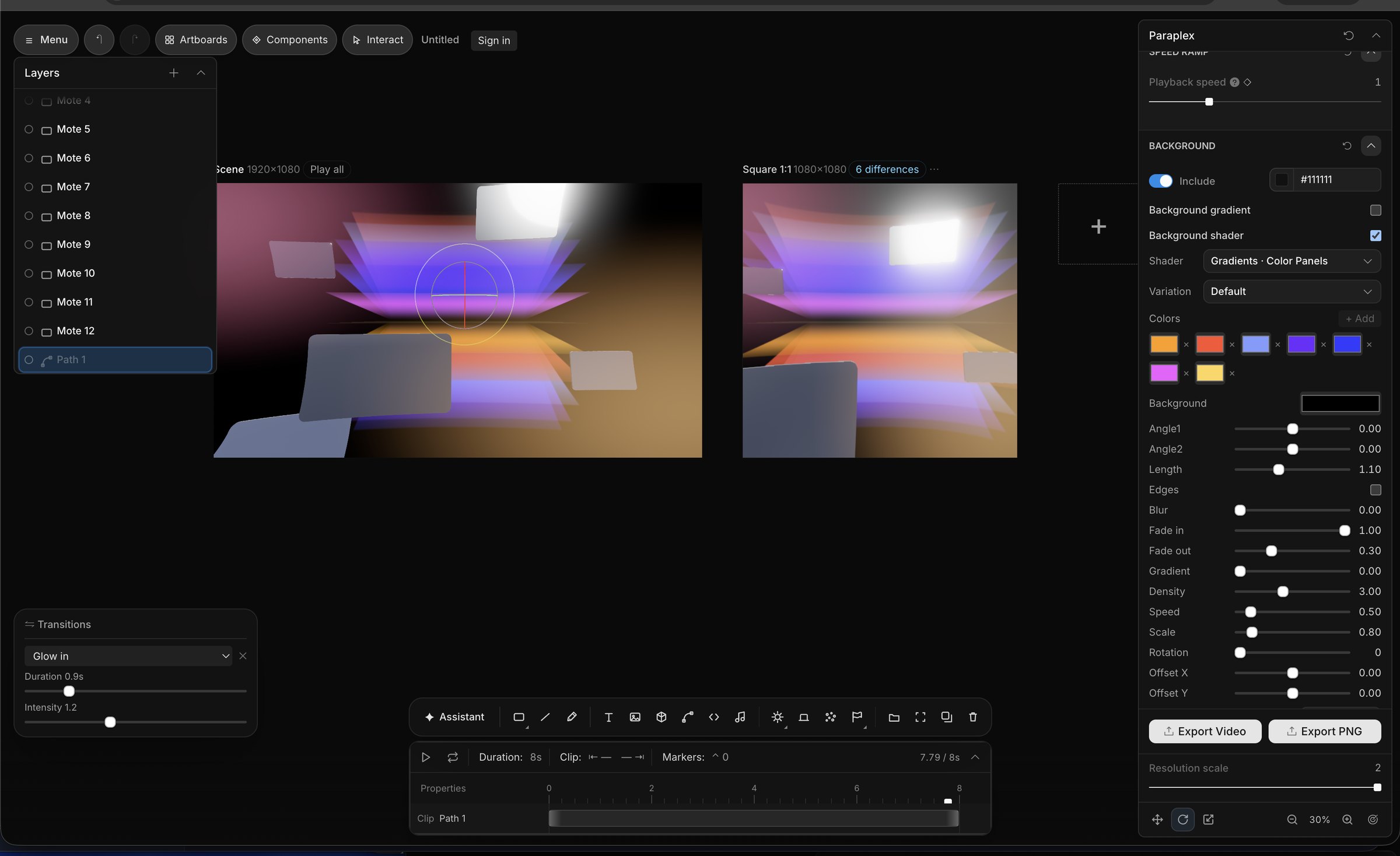
Screenshot of the editor interface for Paraplex, a 3D motion design app, featuring a timeline, panels with editable sliders and settings for things like glass material refraction, dispersion, IOR, transmission, and other panels like a layers panel and transitions panel and gradient settings with animated keyframes.
Screenshot of AI motion design in the Paraplex app, showcasing the built-in AI assistant producing fully editable outputs that the user can configure in the Paraplex app's UI, and easily make fully 3D scenes from scratch using agentic AI workflows.
A screenshot of the UI from the Paraplex app, displaying a series of sliders and settings used to build 3D motion graphics in the browser, including abstract meta blobs and liquid glass shapes
Paraplex and Jitter compared feature by feature, as of October 2026
ParaplexJitter
3DReal 3D scenes: physically based glass, chrome and metal, lights, HDRI and shadows; path-traced Studio render (Pro); GLB and glTF importNo native 3D scenes; 3D flip effects and AI-built 3D rotations on flat layers
GlassLiquid glass with 10 keyframeable dials, inside a lit 3D sceneAn animatable 2D glass effect with refraction, depth, dispersion, frost and light controls (May 2026)
AIAn assistant with 140 tools edits layers, keyframes, camera and materials; every turn is a preview you Apply or Discard; Director mode storyboards firstJitter AI and Superagents edit layers on the canvas, in Balanced (Claude Sonnet 5.5) or Smart (Claude Opus 5.5) mode; Jitter MCP in beta since October 20, 2026
TimelineKeyframe timeline with a diamond on every setting, 23 easing presets and springs; pieces up to an hour at 10 to 120 fpsAction-based timeline with no keyframes required; easing presets and custom curves
Video exportFree: 1080p at 30 fps, no watermark. Pro: 4K at 60 fpsFree: 720p at 30 fps, with a watermark. Pro: 1080p at 60 fps. Max and Ultra: 4K at 120 fps
FormatsMP4, WebM, GIF, PNG, Lottie (flat layers), USDZ and a live web embedMP4, MOV, WebM, GIF and Lottie; ProRes on Pro and up
Transparent videoWebM with alpha and PNG sequences, free to 1080p at 30 fpsProRes 4444 and WebM, on Max and up
Data and variantsCharts from a pasted CSV; one version per spreadsheet row, columns matched to layers by name; every format and variant in one batch on ProBulk Create from a CSV for text and image swaps (July 2026); chart templates; batch export on Max and up
Live web embedInteractive embed with hover, click, drag, scroll, state machines, breakpoints and an embed APINot listed; exports video, GIF and Lottie
Templates77 in 13 categories300+
CollaborationNo real-time co-editing yet; shareable links, links to an editable copy and notes on the canvasReal-time co-editing and comments in a shared workspace; up to 10 editors on Pro and 50 on Max
FigmaPaste SVG from Figma as editable vector paths; import design tokens from Figma variable exportsFigma plugin used by more than 300,000 designers
PriceFree plan; Pro $19/mo billed yearly or $24 month to monthFree plan; Pro, Max and Ultra are billed per editor (prices at jitter.video/pricing)
Paraplex and After Effects compared feature by feature, as of November 2026
ParaplexAfter Effects
Where it runsIn a browser tab, nothing to install; projects sync once you sign inDesktop app for Windows 11 or macOS 15 and later; 16 GB of RAM minimum
PriceFree plan with 1080p exports and no watermark; Pro $19/mo billed yearly or $24 month to monthUS$22.99/mo on an annual plan billed monthly (US$263.88 prepaid yearly), or $34.49 month to month; also in Creative Cloud Pro; 7-day free trial
Built forMotion graphics: launch and demo videos, animated type and charts, website heroes, social postsMotion graphics, compositing and visual effects for film, TV and video
3DEvery scene is real 3D: physically based glass, chrome and metal, lights, HDRI and shadows; path-traced Studio render (Pro)Advanced 3D renderer, parametric meshes and Substance 3D materials, extended to 3D text and shapes in 27.0; GLB, glTF, OBJ and FBX import; Cinema 4D Lite included
AIAn assistant with 161 tools builds layers, keyframes, camera moves and materials; Director mode storyboards first; every turn a preview you Apply or DiscardAI Assistant panel in 27.0, still labeled beta: organizes projects, writes and fixes expressions, edits text and shape layers, exports Motion Graphics templates, generates images and video; most actions use credits
AI agents (MCP)Public MCP server on npm today: Claude Code or another MCP client builds and edits scenes in your open Paraplex tabLocal MCP previewed at Adobe MAX 2026 for After Effects, Premiere, Photoshop and Illustrator; private beta planned for early 2027
TimelineA keyframe on every setting, 23 easing presets and springs; pieces up to an hour at 10 to 120 fpsKeyframes, graph editor and JavaScript expressions; compositions well beyond a minute
Footage and VFXMasks, blend modes, adjustment layers and an effect library; video layers from MP4, WebM and MOV; built for motion graphics, not finishing footageKeying, motion tracking, Roto Brush and Object Matte, a large effects library and third-party plugins
Video exportMP4 and WebM; Free 1080p at 30 fps, Pro up to 4K at 60 fpsH.264, ProRes and more through the Render Queue or Adobe Media Encoder
Transparent videoWebM with alpha and PNG sequences, free to 1080p at 30 fpsProRes 4444 and other formats with alpha
Every aspect ratioArtboards for 16:9, 9:16, 1:1, 4:5 and 4:3 with Responsive framing; export all enabled in one goUsually a separate comp per aspect ratio
Web and LottieLive interactive embed (hover, click, drag, scroll, state machines); Lottie export built inNo live embed; Lottie through the free Bodymovin or LottieFiles plugins
DataCharts from a pasted CSV; one version per spreadsheet row, batch export on ProCSV and JSON files can drive layers through expressions
Review and sharingReview links with comments pinned to a moment and a spot on the frame, no reviewer account needed; Teams with Owner, Editor and Viewer roles; no real-time co-editingFrame.io for Creative Cloud included for review and approval
Paraplex and Figma Motion compared feature by feature, as of October 2026
ParaplexFigma Motion
Where it runsIn a browser tab, nothing to install; projects sync once you sign inInside Figma Design files, in the browser or Figma's desktop app; switch the toolbar to Motion
Status and priceFree plan with 1080p exports and no watermark; Pro $19/mo billed yearly or $24 month to monthOpen beta since June 24, 2026, for Full seats on every plan; free Starter exports capped at 1080p and 30 fps; Professional Full seat $16/mo billed yearly
Built forFinished motion: launch and demo videos, social cuts, animated type and charts, website heroesUI and product motion inside the design file, handed to developers as code
3DEvery scene is real 3D: physically based glass, chrome and metal, lights, HDRI and shadows; path-traced Studio render (Pro)2D canvas; 3D transforms (z-axis rotation of frames, vectors and text) announced, on a waitlist
AIAn assistant with 140 tools builds layers, keyframes, camera moves, materials and charts; every turn a preview you Apply or DiscardThe Figma agent adds keyframes from a prompt, grounded in your components and tokens; paid plans, uses Figma AI credits
TimelineA keyframe on every setting, 23 easing presets and springs, 40+ text presets; pieces up to an hour at 10 to 120 fpsKeyframes for position, scale, rotation, opacity and shader properties; easing curves, springs, presets and text by character, word or line
Design systemComponents and instances, design systems with motion tokens, W3C design token importAnimated components, motion variables with modes and custom animation styles, published to team libraries
Video exportMP4 and WebM; Free 1080p at 30 fps, Pro up to 4K at 60 fps; transparent WebM and PNG sequences on bothMP4, WebM, GIF and animated SVG; above 1920×1080 or 30 fps on paid plans
Audio and captionsElevenLabs voiceovers with word-by-word captions, AI sound effects and music, beat detection; SRT and WebVTT exportAudio files on the timeline, trimmed and exported with MP4 and WebM
Every aspect ratioArtboards for 16:9, 9:16, 1:1, 4:5 and 4:3 with Responsive framing and social safe zones; export all enabled in one goEach export is a top-level frame at the size you set; no per-format reframing in Figma's documentation
Lottie, code and webLive interactive embed (hover, click, drag, scroll, state machines); Lottie export of flat layers; no CSS or React code exportCSS, JSON and React code from Dev Mode, plus context for coding agents through the Figma MCP server; Lottie and dotLottie export (shaders and video unsupported)
DataCharts from a pasted CSV; one version per spreadsheet row, batch export on ProNo chart-from-data tool or per-row versions in Figma Motion's documentation
CollaborationShareable links, an editable copy by link, notes on the canvas; no real-time co-editingReal-time multiplayer editing in Figma, with comments pinned to a moment on the timeline
The Paraplex assistant panel with a finished turn waiting for Apply or Discard

Screenshot · an assistant turn waiting for Apply

One scene on three artboards in Paraplex, with Responsive framing re-stacking the blocks for the 9:16 artboard

Screenshot · Responsive re-stacks the 9:16 artboard