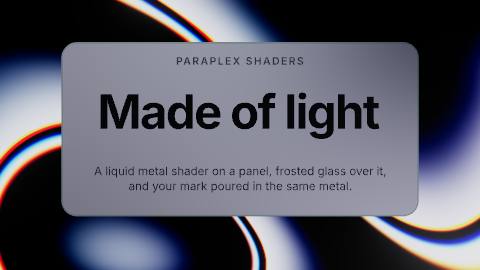
Concept render

Real solids, not stacked layers.
Rectangles take depth, bevels and smoothed corners; spheres, cylinders, cones and tori are true solids; and Combine joins shapes into one by union, subtract or intersect.
Every Paraplex scene is real 3D. Glass, chrome and wood answer to light from studios, skies and HDRI panoramas, and shadows land where they should. It edits like a flat slide until you want depth, and it all runs in your browser.
Unlimited free 1080p exports. No watermark. Runs in your browser.

Most motion graphics fake depth with flat layers and drop shadows. In Paraplex, every scene is a real 3D space: surfaces are physically based, light comes from real environments and the lights you place, and shadows, reflections and bounce light follow it. Until you want depth, it edits like a flat slide.
The settings that shape light and surface carry a keyframe diamond, so the look of a scene can change over time, not just its layout.
Render needed · 3D-02a
Env rotation, 0° to 360°
6 s loop · 16:9, center-safe 1:1 · canvas only
A chrome sphere and a clear glass card on a graphite floor in Studio Contrast. Key Env rotation through one full turn so the softbox reflections travel across both. Same set for all four dials.
Env rotation
Turn the environment around the scene and reflections slide across chrome and glass.

Render needed · 3D-02b
Exposure, low key to bright
6 s loop · 16:9, center-safe 1:1 · canvas only
Same set. Key Exposure from a dark, low-key frame up to a bright studio and back, so highlights bloom and roll off under Filmic tone mapping.
Exposure
Brighten or darken the whole frame, like a camera's exposure.
Render needed · 3D-02c
Roughness, 0 to 1
6 s loop · 16:9, center-safe 1:1 · canvas only
Same set. Key the sphere's Roughness from 0 to 1 and back, so its mirror reflections of the softboxes spread into a soft satin sheen.
Roughness
From 0, a mirror with sharp reflections, to 1, chalky and soft.
Render needed · 3D-02d
Transmission, solid to glass
6 s loop · 16:9, center-safe 1:1 · canvas only
Same set with white stripes behind the card. Key the card's Transmission from 0 to 1 and back, so an opaque white card clears into glass that bends the stripes, with dispersion on at a physical amount.
Transmission
Let light through and the surface turns to glass, bending what sits behind it.
Pick one of eleven environments, from Studio Soft and Softbox Duo to Golden Hour and Night, or light the scene with a 360° HDRI: eight panoramas ship in the library, or bring your own .hdr, .exr or Ultra HDR JPEG. Skies and HDRIs can show behind the scene, with a real ground that takes the shadows.
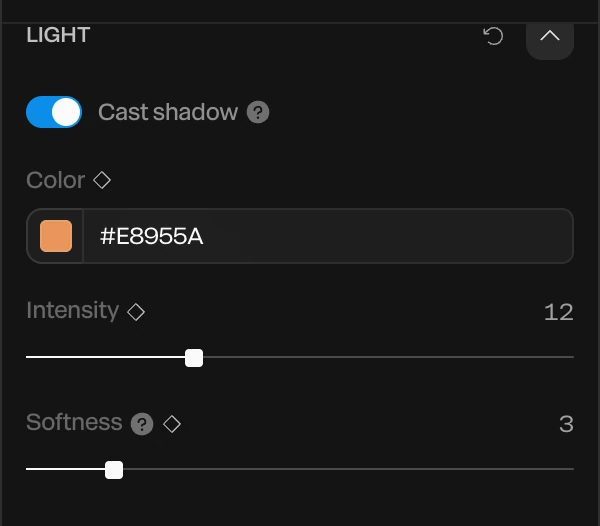
Every environment has a key light you can aim, raise and soften. Add spot, point, directional, area and ambient lights as layers, or a 3-point setup in one click. Tone mapping decides how that light reaches the screen: Filmic or AgX when highlights should roll off like film, Neutral or None when brand colors have to stay exact.
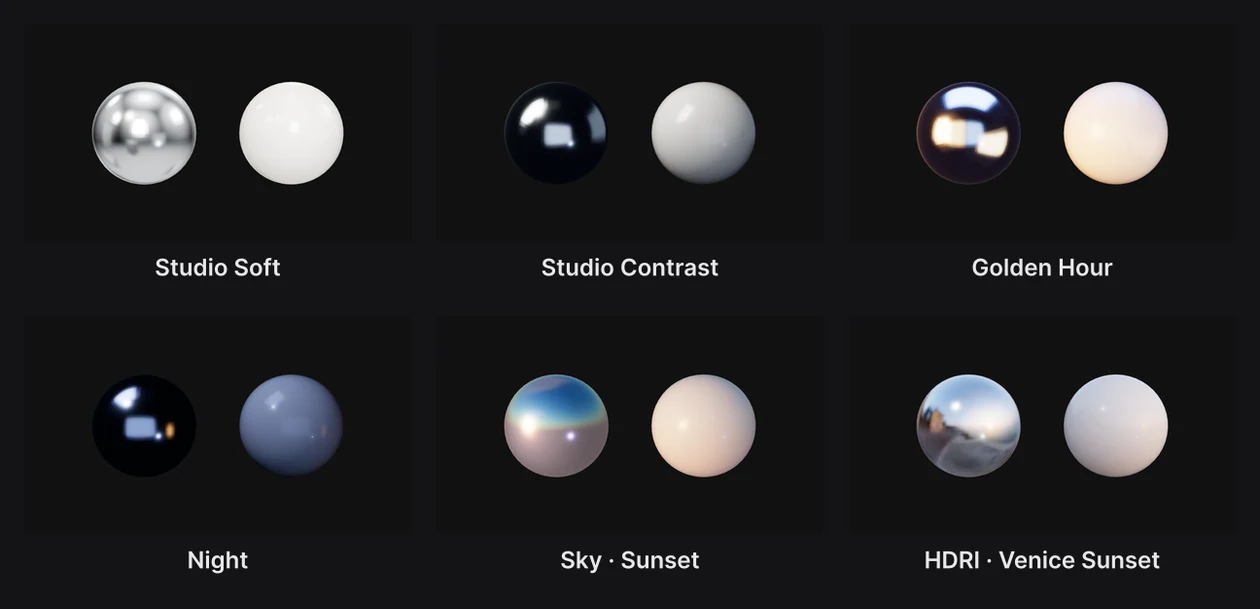
Screenshot · one scene, six environments
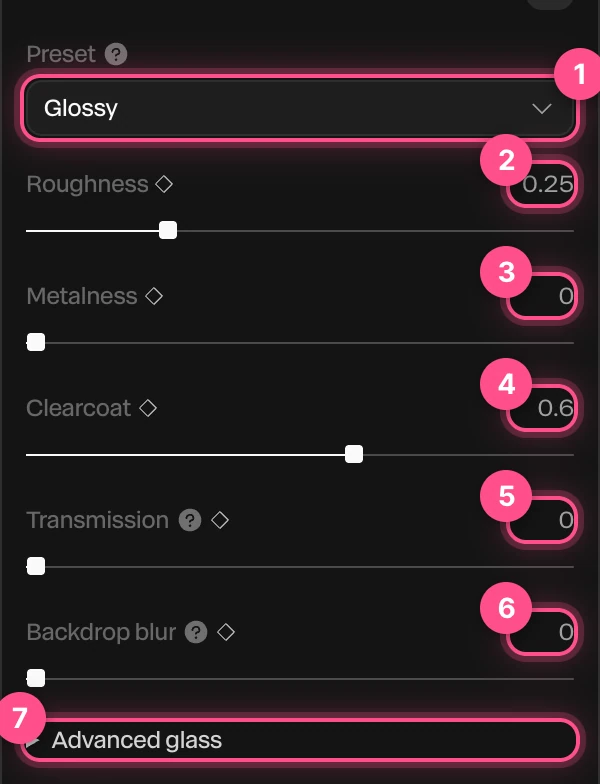
Seven material presets (Matte, Glossy, Glass, Frosted glass, Metal, Fabric and Unlit) set roughness, metalness, clearcoat, transmission and backdrop blur, and each of those dials keyframes. Physical glass adds refraction, dispersion, iridescence, anisotropy and sheen.
Or start from one of 21 finished looks, such as oak, terracotta, porcelain, brushed steel, chrome, gold, velvet, crystal and dark glass, then add one of ten procedural textures or your own picture with a normal map. Save a material and every layer that follows it updates when you change it.

Screenshot · seven presets, one sphere
Concept render
Real solids, not stacked layers.
Rectangles take depth, bevels and smoothed corners; spheres, cylinders, cones and tori are true solids; and Combine joins shapes into one by union, subtract or intersect.
Concept render

Press D for flat.
2D mode holds the camera head-on, with smart guides and an 8-point grid, so a 3D scene lays out like a design tool.
Concept render

Every light is a layer.
Move it, color it, keyframe its intensity and softness, or save the setup as a lighting rig for the next scene.
Concept render

Pictures and code join the scene.
Wrap a world map round a sphere to make a globe, play video on a glossy card, or stand live HTML or a React component up as a card in 3D space.
An invisible floor catches a soft contact shadow and the lights' own cast shadows, so objects stand on something over any background. Raise Caustics and glass throws a moving web of light onto that floor in its own tint, the way real glass does in sunlight.
Turn any shape into a reflective floor that mirrors what stands on it. Ambient occlusion darkens the creases where surfaces meet, and bounce light lets one surface light the next. On Pro, a transparent export keeps the shadows and caustics as soft alpha, ready to drop over footage.
Screenshot · caustics under a glass card
Turn on Studio render (Pro) and Paraplex path-traces the frame. It follows light as it bounces between things, so shadows soften with the size of each light, glass bends what's behind it, and every surface reflects the others. Quality runs from Draft at 32 samples to Final at 1024, and every exported frame is traced at that setting.
Tracing takes time, so it pays off on stills and short loops with glass, metal and a floor. Particles, lines and flat interface layers are drawn over the traced frame as usual.
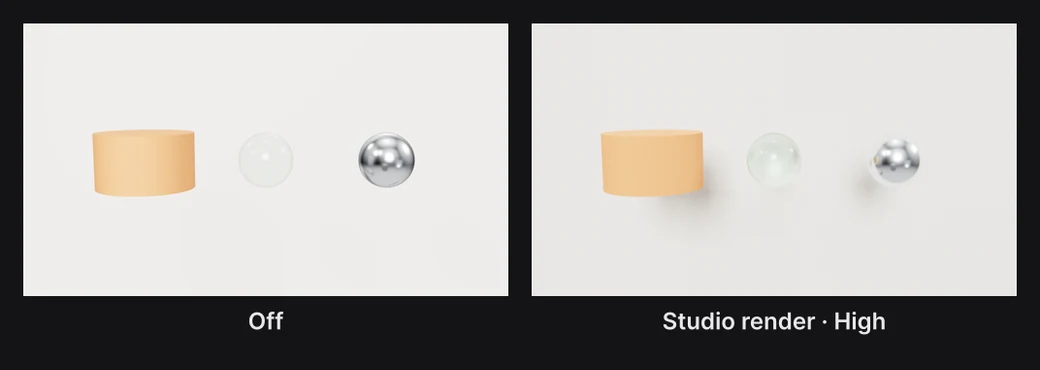
Screenshot · normal view vs Studio render
Website heroes, launch videos, logo reveals and product films all look more expensive in real light. Every card here is a real Paraplex template, playing in its own.

Chrome & glass hero template
Lit in real 3D
Loop chrome and glass behind your headline as studio light sweeps across them, then export a live web embed or a light video for the page.
Templates: Chrome & glass hero, Liquid metal hero
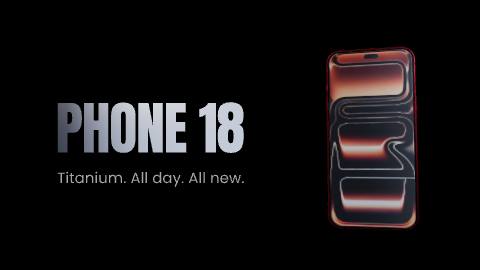
Product launch template
Lit in real 3D
Set your product on a reflective floor under studio light, then cut to the price and the date. Export 16:9 for the keynote and 9:16 for social from the same scene.
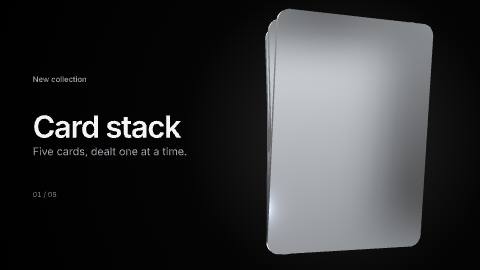
Templates: Product launch, Card stack, chrome
Chrome logo reveal template
Lit in real 3D
Put your logo in chrome under a moving light, with its reflection and shadow on the floor. Chrome logo reveal is a premium template, included with Pro.
Templates: Chrome logo reveal, Card stack, glass
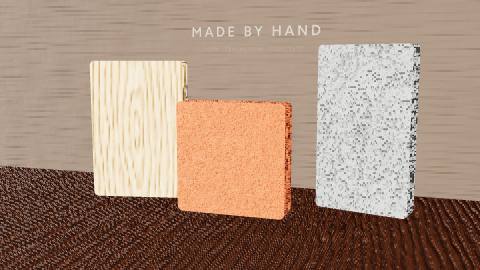
Wood and clay template
Lit in real 3D
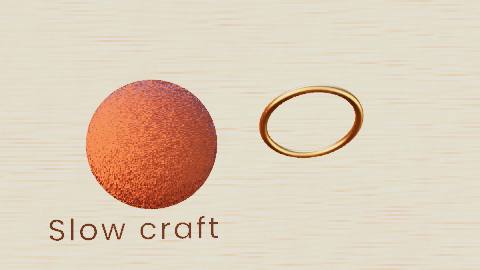
Oak, clay and dark glass from the one-click looks, lit low and warm so grain and edges catch the light. For brands that sell how things are made.
Templates: Wood and clay, Slow craft
The materials, lights and render settings in every Paraplex scene, counted in the app on October 9, 2026.
11
lighting environments, from studios to skies
21
one-click looks, from oak to dark glass
Matte, Glossy, Glass, Frosted glass, Metal, Fabric and Unlit
Roughness, metalness, clearcoat, transmission and backdrop blur
Refraction, dispersion, iridescence, anisotropy and sheen
Ten procedural textures, or your own picture with a normal map
Spot, point, directional, area and ambient lights
A 3-point setup or Dramatic light in one click
Key light direction, height and softness, plus fill
Eight HDRI panoramas, or upload your own
Ambient occlusion and bounce light
Contact and cast ground shadows, caustics and reflective floors
Tone mapping: Filmic, AgX, Neutral or None
Studio render from Draft at 32 samples to Final at 1024 (Pro)
3D models generated from a description
Liquid glass on any shape
Depth of field from ƒ/1.4 to ƒ/16, with focus pulls
GLB and glTF models that light and cast shadows
Eight camera moves, from Orbit to Dolly zoom
3D text in chrome, glass or liquid metal
Gaussian splats from Polycam, Luma or Postshot
Randomize new glass settings, one undo each
Chrome, glass, wood and clay, already lit. Open one and swap in your words, logo and colors.
Yes. Paraplex runs in the browser with nothing to install. Every scene is real 3D with physically based materials, environment lighting and shadows, and you animate it on a keyframe timeline, then export MP4, WebM, GIF or a live web embed.
Real 3D. Each scene is a 3D space with physically based materials, cast shadows, ambient occlusion and bounce light, and the camera can move among layers at different depths. Press D for 2D mode and it edits head-on like a flat design tool until you want depth.
Eleven environments, including studios, Golden Hour, Night and three skies, plus HDRI lighting from eight library panoramas or your own .hdr, .exr or Ultra HDR JPEG. You can add spot, point, directional, area and ambient lights as layers, or a 3-point setup in one click.
Filmic or AgX for lit 3D scenes, where highlights should roll off like film. Neutral for products and brand colors, which stay true. None shows every color exactly as set, for flat designs, though lit highlights clip.
Yes. Paraplex imports GLB and glTF models from tools such as Blender, Cinema 4D and Spline; they light, cast shadows and export like any layer, and can play their own animations. It also reads Gaussian splats, and can generate 3D models from a text description.
Yes, on Pro. Studio render path-traces each frame, from Draft at 32 samples to Final at 1024, so shadows soften with each light's size and glass bends what's behind it. Every exported frame is traced, which makes long videos slow to export, so it suits stills and short loops.
Start free in your browser. Upgrade when your work needs 4K or Studio render.
Paraplex is a browser-based 3D motion design studio with an AI assistant that edits real layers and keyframes.